1 min read
The Hidden Risks of Manual First Responder Checklists
Why manual checklists create risk that is easy to miss Paper checklists and logbooks feel familiar. They live in the cab, on a clipboard, or on a...


This on-demand webinar, hosted by PSTrax and integration partner Fleetio, shows how Fire, EMS, and Law Enforcement agencies can manage fleet readiness from inspection through repair.
Watch Webinar
This brief On-Demand PSTrax webinar shows practical ways to gain better visibility into your supplies, simplify purchasing, and cut down on manual work.
Watch Webinar
6 min read
“Inspections” can mean very different things in public safety software.
In a records management system, inspections often refer to occupancies, fire codes, and prevention work. In a readiness system, they refer to the apparatus, equipment, PPE, SCBA, supplies, and controlled substances crews depend on every day.
Some platforms support both. But seeing “Inspections” or “Inventory” on a feature list does not tell you how well the system handles either job.
The real question is whether the software can support your department’s actual apparatus layouts, checklists, schedules, accountability requirements, and corrective actions. That is where the difference between a listed feature and a purpose-built readiness workflow becomes clear.
The traditional core of a fire department RMS includes:
This is mandatory, valuable work, and a strong records platform handles it well.
The bundling argument is reasonable, too. One contract, one procurement cycle, and fewer vendors to manage can provide a real administrative benefit, especially for departments without dedicated IT staff.
Some broader platforms also offer apparatus checks, equipment management, inventory, and other operational modules. Their capabilities vary considerably, which is why departments should evaluate the actual workflow rather than relying on the module name.
Much of an RMS follows the incident and reporting cycle. Reports are completed after calls, records are retained, and required information is submitted to local, state, and national systems.
Readiness follows the shift clock.
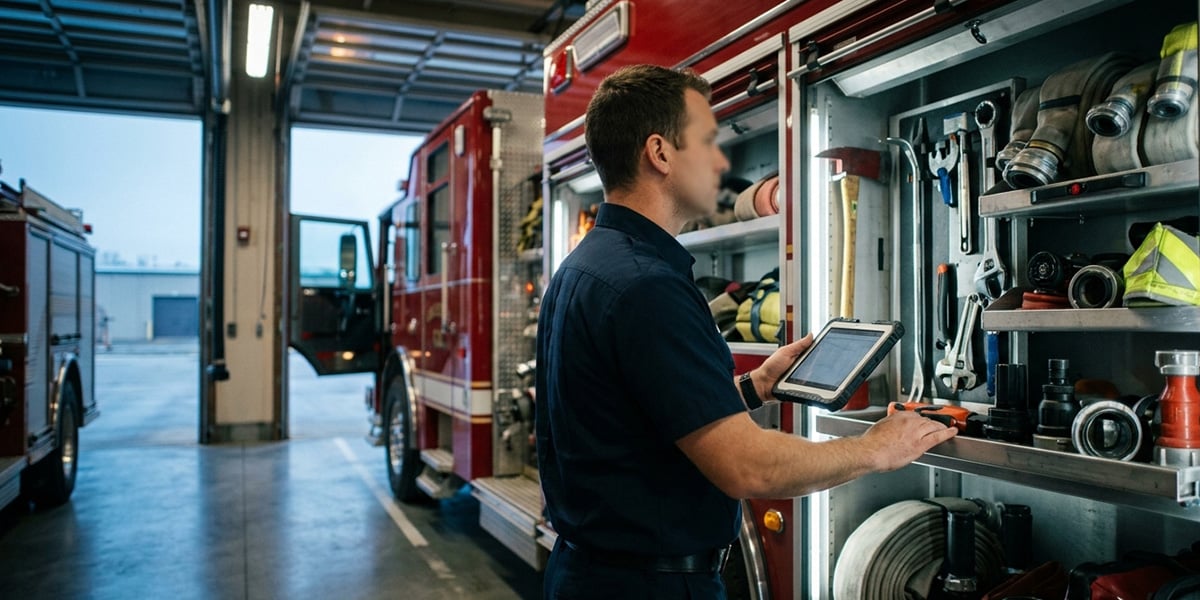
Apparatus, equipment, PPE, SCBA, medical supplies, and controlled substances may need to be checked at the start of a shift, after use, or according to a recurring schedule. Deficiencies need to be documented, assigned, and resolved before they become larger problems.
That is the work a true first responder readiness software is designed to support.
Same department. Same day. Different questions and different workflows.
In the traditional RMS context, “inspections” often refers to occupancy inspections, fire code inspections, or other community risk reduction work.
In a readiness context, “inspections” may refer to:
Some public safety suites support both types of inspections. The question is how deeply they support the readiness side.
Can the system reflect the department’s actual apparatus and compartment layout? Can it track individual equipment records, service dates, expiration dates, failed checks, and corrective actions? Can multiple crew members complete assigned portions of the same inspection? What happens when the fleet, policy, or checklist changes?
Those details determine whether a system supports the way crews actually work or simply provides another form to complete.
Think about how your department purchases an apparatus.
A committee may spend months reviewing compartment depth, hose bed height, pump capacity, aerial length, equipment placement, staffing, and the hazards within the response area. The final specification reflects the department’s actual needs.
The committee also decides what not to purchase. Every item has to justify its place because the department will pay for and maintain it.
Software deserves similar scrutiny.
A generic inventory or inspection template may not match the compartments on the apparatus, the equipment assigned to it, or the sequence crews use when completing checks. When the workflow does not fit, personnel may create workarounds, keep separate paper records, or click through requirements without performing a meaningful inspection.
That is how inspections can become inconsistent from crew to crew.
Departments should bring their real checklists, apparatus layouts, and equipment records into the evaluation. Ask each vendor to show how the system would support them.
PSTrax builds each agency’s system around its existing apparatus, equipment, checklists, schedules, and personnel structure. Departments provide the information in the format they already use, and the PSTrax team handles the initial configuration.
When a department adds apparatus or updates a checklist, it should also understand how those changes are handled, how long they take, and whether additional charges apply under its agreement.
Two engines from the same manufacturer, purchased three years apart, may not carry the same equipment or use the same compartment layout. A ladder company serving one district will not necessarily be configured like a ladder company in another.
A readiness system should reflect each apparatus as it is actually deployed.
That includes:
Configuration matters because a checklist that does not match the apparatus creates friction. Over time, that friction can affect adoption and record quality.
Fire and EMS agencies may need to document work performed under adopted standards, regulations, manufacturer instructions, medical protocols, and department policies.
Examples may include:
Applicable requirements vary by jurisdiction and depend on which standards have been adopted by the authority having jurisdiction.
The software does not create compliance by itself. It helps the department document required checks, identify deficiencies, track corrective action, and retain a defensible history of the work performed.
These records may become important during an internal investigation, regulatory review, insurance claim, lawsuit, accreditation review, or controlled-substance audit.
our department still needs its records platform. A readiness system is not intended to replace incident reporting, patient care reporting, prevention records, or preplans.
It supports a different body of work: the recurring inspections, inventory controls, maintenance records, and accountability processes that help departments keep personnel and equipment ready.
PSTrax is designed to work alongside the systems a department already uses, including integrations and partnerships with First Arriving, Fleetio, Life-Assist, and Bound Tree Medical.
Using multiple systems carries trade-offs. Departments should evaluate integrations, user access, data ownership, support responsibilities, system availability, and the consequences of one platform becoming unavailable.
The advantage of a specialized provider is focus. PSTrax concentrates its product development and implementation experience on daily checks, equipment accountability, inventory, maintenance documentation, and related readiness workflows.

“The biggest value is taking a ton of formal and informal systems and putting them into one collective effort that provides information from the executive chief level all the way down to the user.”
– Curtis Brown, Retired U.S. Army Colonel, Logistics and Procurement Manager
Prince William County Fire & Rescue (VA)
Bring these questions to your next demonstration or renewal:
Most importantly, bring one of the inspections your crews currently perform. Ask the vendor to demonstrate that exact workflow instead of relying on a standard product presentation.
Your RMS creates and retains the records associated with incidents, patient care, prevention, and reporting.
A readiness system provides a documented history of the inspections, inventory controls, deficiencies, and corrective actions used to help keep crews and equipment ready before the next call.
Some platforms attempt to handle both. Others specialize. What matters is whether the system performs the work at the level your department requires.
Bring us an inspection your crews complete every day, and we will show you how PSTrax handles it. Ask every other vendor to do the same.
The difference between a listed feature and a fully supported workflow should become clear quickly.
See how PSTrax tracks daily inspections, apparatus, equipment, inventory, and compliance documentation before the next call.
Schedule a convenient time with our team today.
Does a records management system cover apparatus and equipment inspections?
Sometimes. Some public safety platforms offer apparatus checks, equipment management, inventory tracking, and related workflows. The depth and configuration can vary considerably. Departments should evaluate whether the system supports their actual apparatus layouts, inspection schedules, equipment records, deficiencies, corrective actions, and documentation requirements.
Do we have to replace our RMS to add a readiness system?
No. A readiness system can work alongside the records platform you already use. PSTrax is designed to support daily checks, inventory, maintenance documentation, and equipment accountability without replacing your incident reporting, patient care, prevention, or preplanning systems.
How long before our crews are working in PSTrax?
Most agencies can begin working in PSTrax within weeks, depending on the size and complexity of the implementation. You provide your existing checklists, apparatus list, equipment records, and roster, and the PSTrax team configures the system around them before your crews begin using it.
1 min read
Why manual checklists create risk that is easy to miss Paper checklists and logbooks feel familiar. They live in the cab, on a clipboard, or on a...
1 min read
When fire and EMS departments evaluate a new readiness platform, the discussion usually comes down to a few practical questions. Is it easy for crews...
1 min read
Most departments aren’t searching for inventory software because things are going well. They’re searching because something broke. An audit surfaced...